Bringing home a new puppy should be a joyful milestone, not a source of stress due to constant biting. At Comprehensive Pet Therapy (CPT), Atlanta’s premier dog training organization, we turn challenges like puppy biting into opportunities for lifelong success. With decades of experience, research-driven programs, and recognition across major media, CPT empowers dog owners to build safe, enjoyable, and lasting relationships with their pets.
Our expert methods go beyond simple tricks. We deliver evidence-based, results-driven outcomes for families who want confidence, reliability, and household harmony from puppyhood through the senior years. As a leader in positive reinforcement canine training, CPT believes that early management of puppy biting establishes a foundation for long-term behavioral reliability, owner confidence, and human-animal bonding. Resultantly, a symbiotic relationship develops that maximizes the quality of life of human family members, the dog, and the pleasure each receives from the other’s companionship.
Puppy biting peaks between twelve and sixteen weeks of age, coinciding with a critical developmental period. During this time, puppies learn important socialization skills and bite inhibition.
Between three and seven months of age, teething contributes to mouthing behavior, as pressure from oral contact helps relieve sore gums. To a greater degree than human children, who emphasize manual contact, puppies explore the world with their mouths. Puppies investigate textures, objects, and people through gentle mouthing and nipping. Since a puppy lacks thumbs, the puppy emphasize his/her mouth to explore and interact with the environment.
Early interactions with littermates and the mother teach appropriate play behavior and social communication. Puppies removed too early from the litter may miss this early learning period. Similarly, puppies born as “singletons” may not receive optimal early play and social exposure. Consequently, puppies experiencing such social deficits may develop abnormal play or social behavior and require formal behavior modification training.
Furthermore, certain breeds, especially herding breeds, such as Border Collies and Australian Shepherds, are more predisposed to nipping. Therefore, herding breed puppies may need extra mental stimulation to redirect biting or nipping instincts.
CPT’s trainers leverage behavioral science and decades of practical field experience to identify breed-specific tendencies and optimize learning outcomes for each puppy.

When you need immediate relief from those sharp puppy teeth, these techniques can provide quick results while you work on longer-term training strategies:
The moment your puppy’s teeth touch your skin, it emits a sharp, loud yelp that mimics the feedback puppies receive from littermates. When puppies bite too hard on their mother or littermate, the other dog often makes a loud yelping sound, warning the puppy that the force of the bite was painful. Timing is crucial; praise immediately after your puppy stops biting.
Cease all interaction instantly when biting occurs. Fold your arms, turn your back, and avoid eye contact. This withdrawal teaches your puppy that biting ends the fun.
Keep a tug or chew toy within arm’s reach. Offer the alternative immediately when your puppy targets your hands or clothing.
Place your puppy in a quiet space for 2-3 minutes if biting persists. Return only after your puppy exhibits calm behavior.
Provided you don’t mind licking as an alternative, immediately reward licking or gentle mouthing with treats and verbal praise. Positively reinforcing desirable licking behavior, while denying attention for biting or nipping behavior, should aid in extinguishing biting, while concurrently increasing the frequency of licking.
The listed interventions align with CPT’s structured training philosophy, ensuring predictable responses that accelerate behavioral improvement and obtain household harmony.
Teach your puppy bite inhibition – the ability to control the pressure and frequency of his/her bite. Bite inhibition is the foundation of all anti-bite training. Bite inhibition training should start the day you bring your puppy home. The longer a behavior endures, the more resistant the behavior is to change. CPT’s proven techniques help puppies develop the self-control needed for safe interaction with humans throughout their lives. Knowing when to start training your puppy is a critical first step for establishing this control.
Practice the “Gentle” Command. Hold a treat in your closed fist and present it to your puppy. Only open your hand when your puppy licks or mouths softly. You can concurrently employ the verbal cue “gentle” or “easy,” although the physical technique of maintaining a closed fist until your puppy ceases biting will more influentially modify his/her behavior. The exercise cognitively and positively teaches your puppy that soft contact results in satisfaction, while biting or nipping does not.
Reward Decreased Bite Pressure – Initially, allow some mouthing while rewarding any decrease in bite pressure with immediate praise and high-value treats. Over 2 – 3 weeks, gradually require more gentle contact before providing rewards. This progressive approach helps your puppy learn bite inhibition naturally and positively.
Use Consistent Verbal Cues – Pair gentle petting rewards with consistent verbal cues like “easy” or “gentle.” The combination of physical and verbal feedback helps your puppy understand exactly what behavior earns positive attention. Yet, as expressed above, the physical technique is more influential than verbal communication. Too much talking can confuse a puppy or backfire by exciting the puppy.
CPT integrates structured repetition and objective measurements to obtain success and monitor progress. This way, we ensure your puppy consistently generalizes soft-mouth behaviors across environments and contexts.
Complete Interaction Cessation – The moment teeth touch skin, completely stop all interaction and fold your arms. Avoid any eye contact, verbal response, or physical movement your puppy might interpret as continued play. The ” withdrawing motion teaches your puppy that biting immediately ends social interaction.
Strategic Room Departure – If your puppy continues jumping or nipping after you’ve stopped interaction, calmly leave the room for 30 – 60 seconds. Return only after your puppy displays calm behavior with all four paws on the floor. Departure is particularly effective for attention-seeking biters.
Consistent Daily Practice – Practice anti-biting solutions 5 – 10 times per day, including when biting occurs spontaneously and during play sessions. Employ techniques consistently across all family members. Everyone must respond similarly to avoid confusing your puppy and to maximize the probability and speed of behavior modification. CPT strongly believes consistency constructs a framework that enables predictable behavioral outcomes and superior owner–dog communication alignment.
Strategic Toy Placement – Keep appropriate alternatives like Kong toys, bully sticks, and rope toys within arm’s reach during all formal training sessions and during informal owner-dog interactions. The faster you redirect your puppy’s attention to an appropriate oral outlet, the more effective the outcome.
Enthusiastic Toy Praise – When your puppy chooses the toy over your hands or clothing, praise enthusiastically and engage in appropriate play with the toy. Praise enhances the perception of reward associated with toy interaction- and should elevate the perceived value of toy interaction above the value of dog-human skin interaction. However, be aware that overly effusive praise may draw your dog away from the toy and toward you, whereby the method becomes ineffective. Therefore, modulate praise accordingly, depending upon the response of your dog.
Regular Toy Rotation – Rotate 3 – 4 toys weekly, where each toy differs in appearance, texture, size, weight, and function. Variety and rotation inhibit boredom. This way your puppy maintains interest in the 4 toys available at any one time. CPT trainers use structured redirection protocols that enhance focus, reduce impulsivity, and build constructive play habits that remain throughout adulthood.
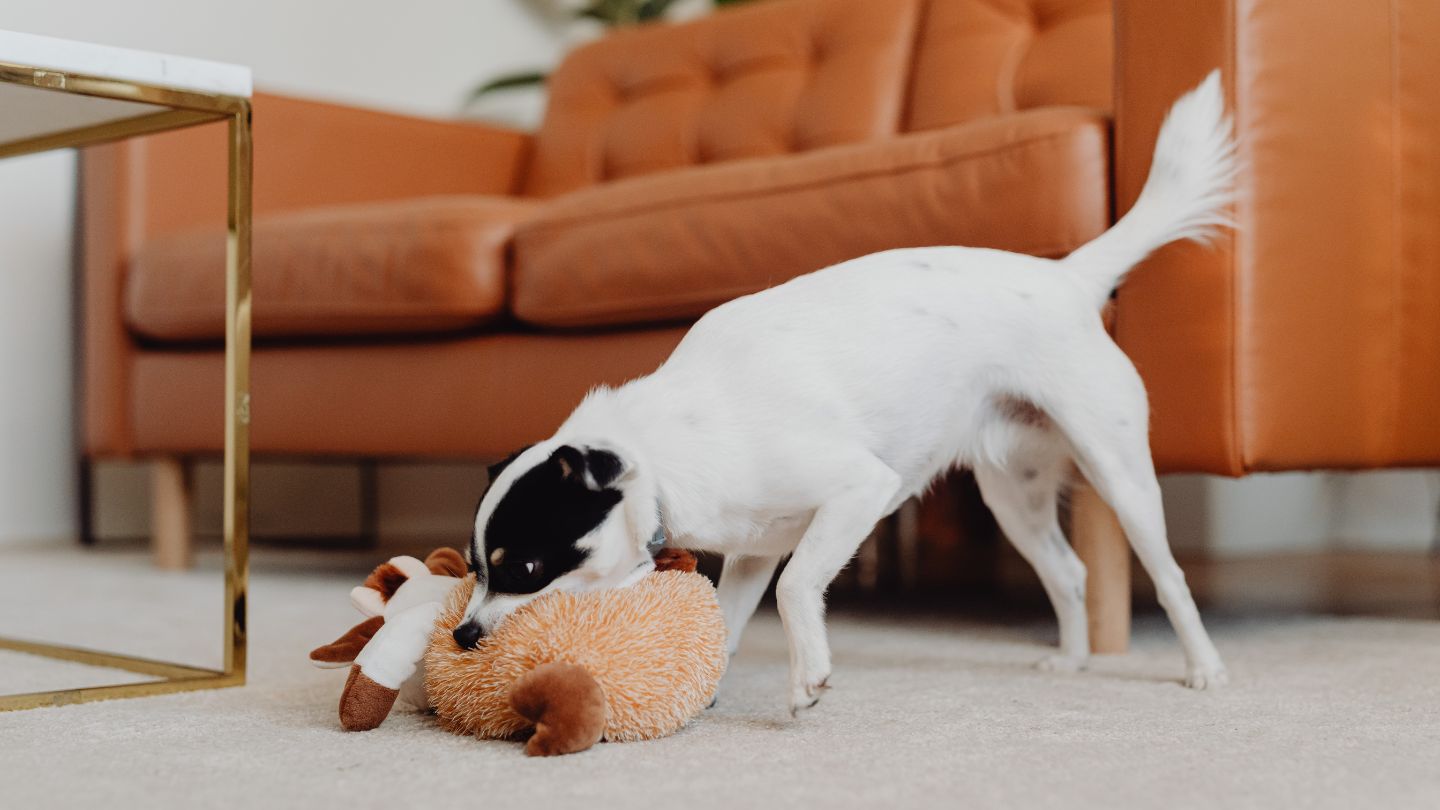
A generally or temporally under-stimulated puppy is far more likely to engage in excessive biting behavior. Proper energy management and structured routines can prevent many biting incidents before they occur. If your puppy is biting excessively, he/she may need more indoor or outdoor exercise or another form of preemptive physical or cognitive stimulation.
Likewise, over-stimulation may prompt biting behavior. Therefore, modulate your puppy’s energy level to a state where your puppy releases pent-up energy, but still remains clear-headed and rule-abiding. If your puppy becomes over-stimulated, then respond with quiet time or an outdoor toileting trip.
Training success is often rooted in having a deeper understanding of things you may not know about dog psychology, particularly how stress, boredom, and overstimulation drive behavior.
Schedule Structured Exercise– Provide 15 – 20 minutes of structured exercise before training sessions or when you observe impending rambunctiousness. A slightly tired puppy is more receptive to learning and remains calmer and better behaved. In contrast, an over-stimulated puppy may enter a “puppy temper tantrum” mode, where he/she has difficulty concentrating, and training becomes ineffective.
Daily Mental Stimulation– Mental stimulation through puzzle feeders, snuffle mats, and training games can be an excellent supplement to physical exercise. Incorporate “brain work” into your daily routine to help your puppy reach a calm, learning-ready state.
Enforce Regular Nap Times– Young puppies need 18 – 20 hours of sleep daily. Unfortunately, many don’t settle on their own. To facilitate a rest state, use a crate or quiet area. Moreover, enforce nap times when biting becomes excessive or when you notice signs of overstimulation, which may include increased nipping intensity.
Recognize Overtired Signals– Watch for warning signs, including hyperactive behavior, increased biting intensity, inability to settle, and resistance to normal cues. When the listed symptoms appear, initiate a quiet time, rather than more training or play.
Establish Consistent Daily Routines– Create predictable schedules. Feeding times, potty break intervals, play sessions, and rest periods should all occur at regular times each day. Consistent routines help prevent energy spikes that often lead to problem-biting behaviors.
Even well-intentioned dog owners can inadvertently make puppy biting worse through common training errors. If you avoid the mistakes listed below, you should significantly accelerate your puppy’s progress.
Never Use Physical Punishment– Do not hit your puppy, perform intimidating alpha rolls, or administer any unnecessary painful physical corrections. Physical punishment poses the risk of creating fear and damaging your relationship. Moreover, if your puppy becomes fearfully defensive, biting behavior may become worse.
Don’t Play Rough Games– Resist the temptation to wrestle or play using your hands until your puppy has established solid bite inhibition. The preceding forms of play can be excellent outlets later in life, but may encourage biting behavior in immature puppies.
Don’t Encourage Mouthing – Even if gentle mouthing of hands or feet doesn’t hurt initially, don’t allow it. What feels fine from a 10-pound puppy can become painful or dangerous as they grow. Teach your puppy that teeth never belong on human skin.
Stop Using a Yelping Solution If It Backfires– While the loud yelp sound recommended previously works for many puppies, some become more excited by the noise. If your puppy increases his/her biting intensity when you yelp, switch to the silent withdrawal method.
Ensure Family Consistency– Inconsistent responses amongst family members retards behavior modification progress. Everyone should follow the same rules and administer the same techniques. Otherwise, your puppy will continue biting/nipping all family members or learn to target the more lenient family member.
While most puppy biting resolves with consistent home behavior modification training, certain situations require professional intervention. If intensive biting behavior continues beyond 6 – 7 months, when your pet has complete adult dentition, we recommend obtaining professional assistance. Most puppies will outgrow their biting phase by the time they finish teething and adult teeth have fully erupted- at 7 months of age or earlier. Therefore, prolonged biting behavior is abnormal and benefits from the participation of a CPT professional trainer.
Owners should also be attentive to signs of resource guarding, such as stiff body language, growling, or protective behavior around food, toys, or resting spots. Resource guarding behavior can escalate quickly and may expose human or animal family members to the risk of injury. CPT’s behavior modification specialists provide psychology-based solutions, ensuring safety, long-term success, and individualized treatment plans.
Understand that your puppy won’t achieve goal outcomes immediately. Therefore, maintaining realistic timelines. Then, both you and your puppy will foster a stronger relationship. Every puppy develops at its own pace. Nevertheless, general patterns can guide your expectations.
Initial Improvement Phase– Most dog owners notice initial improvement within 1 – 2 weeks of consistent training. Biting may not stop completely after 2 weeks. Yet, you should observe a tangible reduction in frequency.
Significant Reduction Period– Expect a significant reduction in biting frequency by 16 – 20 weeks of age. By 4 – 5 months of age, most puppies should develop greater impulse control and understand basic household rules. The worst biting period typically occurs around 12-16 weeks and then gradually improves. However, regardless of the stated age norms, you can accelerate progress via proper human-dog communication, relationship development, and behavior modification training.
Complete Resolution Timeline– Complete resolution generally occurs by 6 -7 months when adult teeth fully emerge, and teething discomfort subsides. Nonetheless, some breeds, particularly Australian Cattle Dogs and other high-drive working and herding breeds, may require ongoing management through their first year.
Daily Training Commitment– Consistent daily training sessions of 10 – 15 minutes produce the fastest results. When working with young puppies possessing limited attention spans, short, frequent training periods are more effective than longer, less frequent training periods. Moreover, you should understand that each interaction with your puppy is a training event, regardless of whether the encounter occurs within a formal training session or informally during normal life activities.
Realistic Progress Expectations– Progress isn’t always linear. Expect occasional setbacks, especially during growth spurts, illness, or major routine changes. This is completely normal and doesn’t indicate long-term training failure.
The reason for the focus on gentle methods is simple: positive reinforcement is the key to successful dog training across all areas of behavior, including biting.
While consistent home training can resolve most puppy biting, expert guidance can accelerate results and ensure the most effective methodology for your puppy’s temperament, breed, age, and lifestyle. This article outlined strategies for immediate relief, bite inhibition, energy management, and socialization, aimed toward transforming a mouthy puppy into a well-behaved companion.
Comprehensive Pet Therapy offers specialized in-home private lessons in Atlanta that address nipping and biting, while building lifelong obedience and social skills. CPT also offers a full menu of group class programs, including beginner obedience, intermediate obedience, advanced obedience, dog agility training, and tricks classes. Group sessions provide socialization, whereas private sessions better target behavioral concerns. In addition, for those who would rather CPT do all the work, CPT has an outstanding board training program. Regardless of the choice of service, CPT’s ongoing support ensures consistent progress.
Yes, biting is normal behavior for a young puppy. Your puppy principally used oral behavior when interacting with littermates. Now, you are his family, and it will take time for your puppy to learn that different behavior is required when interacting with humans. Biting generally peaks between 12 and 16 weeks of age, fueled by social development, teething discomfort, and exploratory instincts. Working and herding breeds often exhibit elevated mouthiness due to genetic predilections. Fortunately, structured training mitigates biting behavior and accelerates maturity.
Immediate play interruption, decisive redirection to appropriate chew items, and high-value reinforcement for soft mouth behavior often yield a rapid impact. Alignment across all family members is the operational backbone for accelerated, sustainable progress.
Leverage soft-mouth conditioning: reward reduced bite pressure; supplement with a verbal cue, such as “gentle,” and end engagement the moment teeth meet skin. Consistent application across daily routines builds predictable, safe interaction patterns.
Engage a CPT behavior specialist if biting persists beyond 6 – 7 months, intensifies in force, or coincides with resource guarding or fear-driven responses. Early escalation management prevents long-term behavioral risk.
Most puppies demonstrate measurable improvement within 1 – 2 weeks of training, with a substantial reduction in biting behavior by 16 – 20 weeks of age. Full resolution typically aligns with the end of teething around 6 – 7 months of age, although high-drive breeds may require extended oversight.

Need to get in touch with CPT? I’ve got you covered.
Pick what works best for you!