Bringing home a new puppy is exciting, joyful, and sometimes overwhelming. Those early weeks shape how your puppy behaves, learns, and adapts for years to come. Focusing early on foundational life skills is important for development, confidence, and safety throughout your puppy’s life. By understanding what to teach first and how to keep training simple, positive, and realistic, you can build confidence, prevent common behavior problems, and set your puppy up for lifelong success.
Comprehensive Pet Therapy (CPT), Atlanta’s most respected pet training company, employs enlightened principles that reflect decades of hands-on experience in canine psychology, canine science, behavior modification, and results-driven training that have successfully educated dogs of all ages. Regardless of whether you own a puppy, young adult, adult, or senior dog, and regardless of whether your dog exhibits a normal psychology or complex behavioral challenges, CPT can adeptly achieve your objectives.
CPT trainers employ these evidence-based strategies to improve your puppy’s reliability, confidence, and long-term household harmony.
Bringing a new puppy home is one of the most exciting moments for dog owners. That tiny ball of energy, curiosity, and adorable chaos fills your house with joy and a fair amount of work. Most puppies exhibit problem behaviors like jumping, nipping, or ignoring the Come command.
The question is whether those undesirable habits remain in perpetuity or whether via effective training you modify them into desirable replacement behaviors. Realize, a puppy’s habits become the behaviors the puppy practices. Without intervention, the habits your puppy develops in those first few months often persist into adulthood.
Behavior research consistently shows that early patterns, both good and bad, become deeply ingrained. Therefore, CPT prioritizes early developmental training via a combination of group class and in-home private instruction. Alternatively, for busy clients who travel frequently for work or pleasure or who have extensive social or familial commitments, we recommend board training.
The life skills you teach your puppy during the first few weeks at your home are focal in shaping the adult dog that inhabits your house for the next decade. Nevertheless, there is a distinction between “life skills” and “obedience cues.” Life skills help your puppy cope in a human world. Life skills include name recognition, coming when called, accepting grooming, showing self-control, and relaxing when alone. Obedience commands, such as Sit and Down, are behaviors useful when teaching and employing life skills.
Many owners ask when to start training their puppy, especially if they’re worried about doing too much too soon. Early puppy training is not about perfection; it is about gentle exposure, confidence building, and setting foundational patterns that make ongoing learning easier and faster.
Most puppies arrive home at 8 weeks of age, in the middle of a critical developmental window. Until about 16 weeks, your puppy’s brain is exceptionally receptive to learning. Studies suggest that young puppies in this stage can be up to 25 times more open to forming new associations in comparison to dogs of adult age. Consequently, this stage provides magnificent developmental opportunities. Five essential skills that make everyday life easier during the week 8 – 16 period include: walking on a loose leash, sitting calmly during greetings, remaining confident and stationary during veterinary exams, confining chewing behavior to designated dog toys, and sleeping quietly at nighttime.
Since a puppy has a limited attentions span, when teaching obedience behaviors, use short sessions of 3 – 5 minutes. Repeating short sessions several times throughout the day works far better than one long session that bores both you and your pup. By integrating food, toys, and praise into your training repertoire, you will build habits that your future adult dog will keep for years to come.
The first life skill, which is also an obedience prerequisite, is teaching your puppy to recognize and respond to his/her name. Before you teach Sit, Stay, or Heel, your puppy should know to look at a person calling his name. Name recognition is the foundation of attention, and attention is the foundation of higher-level obedience. Without a reliable name response, every subsequent training skill remains more difficult to teach and less effective in practical circumstances.
From a behavioral science perspective, name recognition builds conditioned focus. And focused attention is an essential foundation skill CPT requires when training dogs for advanced obedience or service work. CPT also employs focused attention behaviors when engaging in behavior modification training designed to reduce anxiety, aggression, or obsessive-compulsive disorders.
Here’s the basic process:
3 – 5 repetitions per session is sufficient. Name recognition sets the foundation for a reliable recall, which is one of the most requested skills CPT trains across puppies, adolescents, and adult dogs, especially in real-world environments with distractions.
| Mistake | Why It Hurts | What to Do Instead |
| Repeating the name dozens of times | Learned irrelevance | Say it once, then wait |
| Using the name only for unpleasant things (baths, crate time, end of play) | Creates a negative association | Pair the name with treats and fun |
| Using a bored or stern voice | Puppy learns to ignore or avoid unpleasant or uninteresting tones | Keep your voice upbeat and happy |
When you make your puppy’s name the best sound in their world, getting their attention becomes almost automatic.
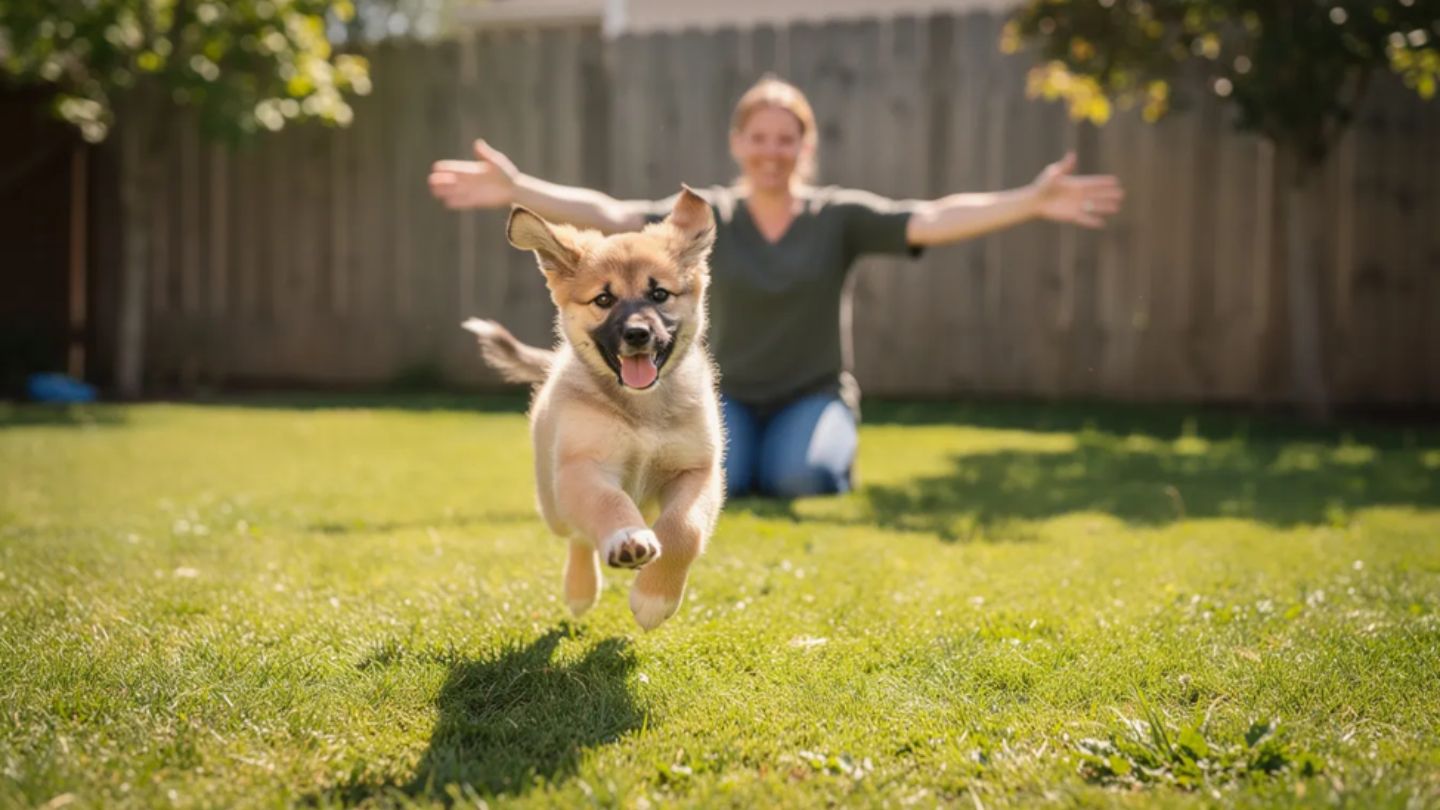
Recall is not just a convenience; it is a safety skill that can save your puppy’s life. Near roads, parking lots, or a busy dog park, a reliable “Come” can prevent accidents.
Statistics show loose dogs face significant risks of traffic-related injury, especially in urban areas. This is why you should begin training recall immediately after introducing name recognition responses.
Start with an easy, fun drill. In your living room or hallway, have a family member or friend gently restrain your puppy, while you kneel a few feet away. Next, open your arms, use an excited voice, and say your puppy’s name, followed by the command “Come!” As your puppy runs toward you, respond with ebullient praise. Once your puppy arrives, reward lavishly with a high-value treat, petting, and play.
Make yourself a “worthwhile destination.” Where proximity to you is more rewarding and fun than any alternative. This creates what trainers call “paid recalls.” Every rapid response to his/her name plus “Come” earns an outstanding outcome. That way, your puppy learns from the onset that running to you is always worthwhile.
Once your pup shows reliable indoor recalls, begin drilling outside with a lightweight 20 to 40-foot long-line. The long line allows you the ability to safely practice with greater distance, while in your yard or a quiet park. Let your puppy explore. When your puppy is distant and inattentive to you, call your puppy’s name and the command “Come.” If your puppy immediately orients toward you and runs toward you, then respond with immediate praise and a high value treat upon arrival. If your puppy, responds slowly, then reward with less enthusiastic praise, and don’t deliver a treat upon arrival. If your puppy continues ignoring you, then use the long line to direct your puppy toward you and praise upon his/her arrival.
Since there are several stages, a solid recall takes months to develop. Therefore, be patient, positive, and diligent. Practice regularly. As your puppy becomes more reliable and responsive, gradually increase distractions and distance.

Some puppies are uncommonly sensitive, anxious, excitable, or distractable amidst certain indoor or outdoor stimuli or contexts. In those cases, private in-home dog training lessons may be the solution for your nervous puppy. Allowing skill-building to happen in a calm, familiar environment, at the puppy’s pace, with a customized private lesson plan, should facilitate more rapid progress and make training more enjoyable for you and your puppy.
CPT frequently develops and implements customized private training and behavior modification programs for dogs of all ages.
Understand that not all puppies respond the same or advance at the same rate. Each puppy is unique. Breed, lineage, parentage, individual genetics, and early developmental experiences significantly influence temperament, behavior, and aptitude. In turn, your puppy’s intelligence, affiliation, confidence, attentiveness, and cooperation- factors that greatly affect your puppy’s learning and performance- depend upon the referenced variables. Fortunately, a professionally designed CPT training plan can minimize the impact of problematic variables and enhance the benefit or positive variables.
Build tactile handling comfort into your puppy’s day by incorporating gentle, brief touches:
Pair each touch with soft praise and tiny treats. Keep your body language calm and relaxed. Your puppy should mirror your energy and emotional state.
A few times per week, conduct 5-minute “grooming practice” sessions:
The key is moving at your puppy’s pace, which might be gradual and slow or might be more rapid, if your puppy inherently enjoys all forms of tactile contact. In week 1, you might touch a paw for one second. By week 4, if your puppy is comfortable, you might clip a single nail. Let your puppy’s comfort level and behavior dictate the pace of advancement.
Impulse control helps prevent three of the most common puppy problems: bolting, grabbing food, and jumping on people. Impulse control training is also a cornerstone of CPT’s work with adolescent and adult dogs, improving reliability, safety, and household harmony.
Sit-Wait-OK is a terrific method for introducing impulse control:
Most puppies catch on within a few trials. To make it easier, first practice the drill with just one or two pieces of kibble in the bowl. Teach your puppy the impulse control provision of “slow is fast and fast is slow.” Adhering to that tenet imprints your puppy that calm, patient behavior is more fruitful than impulsive behavior.
At the front door or yard gate, teach your puppy that doors only open when he/she remains stationary, without attempting to proceed impulsively through the transitional point:
This simple pause protocol can save your puppy’s life by preventing your puppy from bolting into traffic.
Look for natural opportunities to practice brief waits:
“Wait” isn’t a strict obedience “Stay.” Rather, Wait is a practical pause lasting only a few seconds. You are building the habit of thinking before acting, which pays off enormously as your puppy matures.
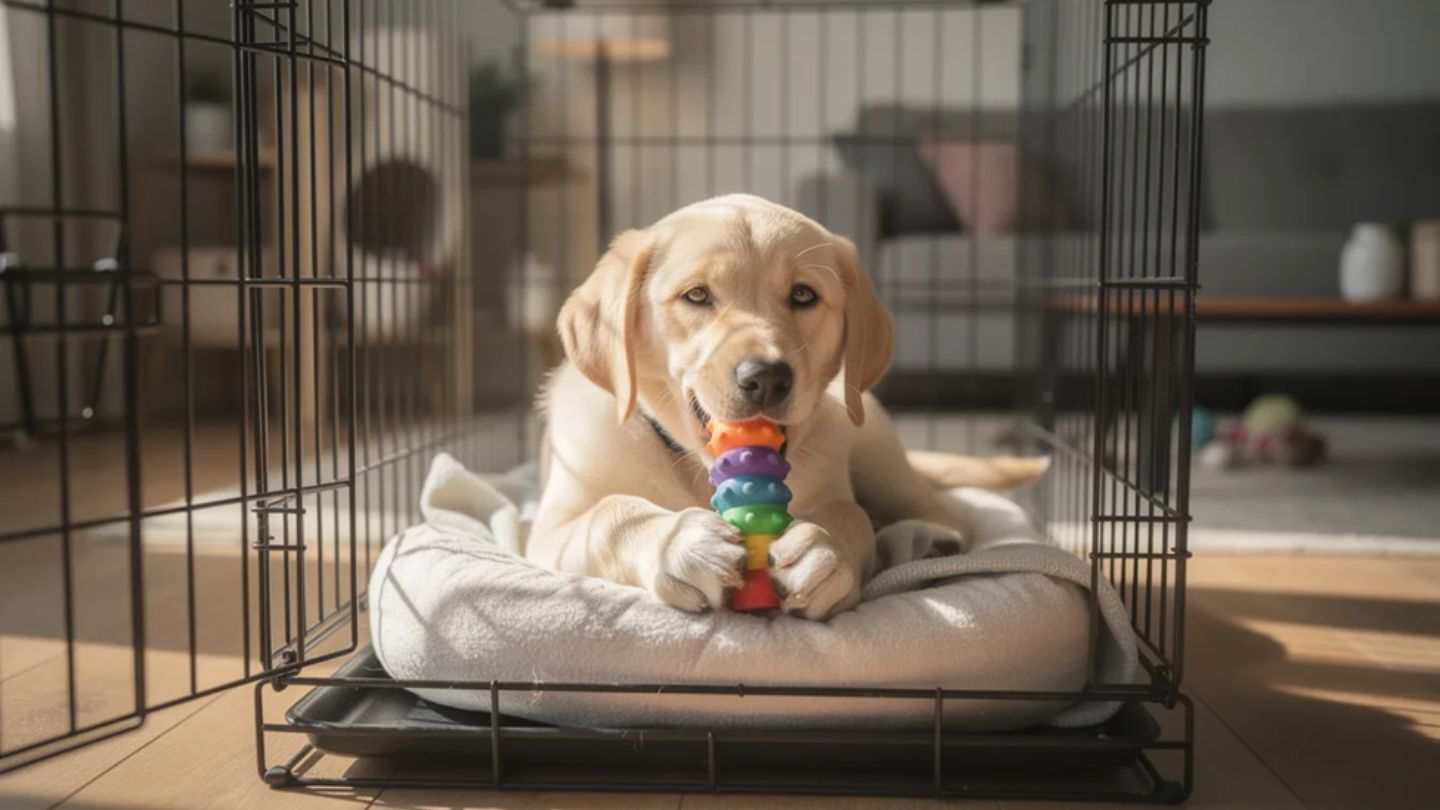
Many puppies develop separation issues. Although there are many origins that may cause or exacerbate separation anxiety, one aspect that is common to all dogs with separation distress is they lack formal conditioning for remaining relaxed when isolated.
Early confinement conditioning reduces the likelihood of a puppy developing separation anxiety and aids in reducing distress in dogs that manifest the condition. During an in-home behavior modification appointment, a CPT Head Trainer can design a separation conditioning program or a program that alleviates anxiety in dogs exhibiting separation distress. The Head Trainer will then teach you how to implement your dog’s customized program in an ongoing basis.
During your puppy’s first week at your home, focus on creating positive associations:
Your goal is to imprint your puppy that the crate is a cozy den, not a prison.
Once your puppy willingly enters the crate, begin adding short confinement with the door closed:
| Week | Duration | Activity |
| Day 1 | 1 – 2 minutes | Door closed, puppy licks a stuffed Kong |
| Day 2 | 5 – 10 minutes | You stay in the room, then briefly exit |
| Day 3 | 15 – 20 minutes | You leave the room, but remain home |
| Day 4+ | 30+ minutes | Gradually extended periods inside the crate |
Repeat these short sessions several times per day. In addition, schedule calm confinement after exercise, outdoor restroom trips, and short training sessions, when your puppy is naturally ready to rest.
Although the above chart measures progress steps in days, move at a pace that is best for your puppy, which may be faster or slower than the progress periods specified in the chart. Some puppies may arrive at your home already conditioned to a crate, due to training conducted by the breeder or due to an innately confident and calm temperament. In such cases, you can progress faster than the standard rate specified in the chart. However, other puppies, especially rescue dogs, anxious dogs, or puppies removed too early or too late from the mother or litter, may require one or more weeks at each level before advancing to the next stage.
With patience and consistency, your puppy will learn to view the crate as a safe, relaxing space.
Now that you understand the five most important skills, here is how to weave the skills into a 10 to 12-week-old puppy’s typical day:
| Time of Day | Activity | Skills Practiced |
| Morning (after breakfast) | Name game (3 min) + Recall game (3 min) | Name, Recall |
| Mid-morning | Crate rest with Kong (20 – 30 min) | Calm alone time |
| Afternoon | Handling practice (3 – 5 min) | Happy handling |
| Before dinner | Wait at the food bowl + wait at the front door | Impulse control |
| Evening | Walk forward on leash + name game in the opposite direction of distractions. | Name, foundation for loose leash walking |
| Evening | Crate rest while you eat dinner | Calm alone time |
Keep a simple one-page checklist where you record:
This takes only seconds to mark and helps you stay consistent, without overcomplicating your puppy’s training.
Keep individual sessions under 5 minutes.
End on a success, even if that means asking for an easier version of the skill. If your puppy achieves a new behavior, celebrate and stop the session. Always quit on a high note.
Expect some regression around 5 – 9 months during the adolescent phase. This is normal and not a sign of failure. Simply step backwards to easier versions of each skill. Then, rebuild gradually. During this period, physical stimulation through play sessions and walks helps constructively channel high energy.
Consistency over the first 3 – 6 months of a puppy’s life builds an adult dog who comes when called, calmly accepts veterinary care and grooming, waits politely, and relaxes when alone. Diligent foundation training makes life easier for the next 10 to 15 years- for both you and your pet.
Raising a well-adjusted puppy emphasizes building foundations that support a lifetime of good behavior. By focusing early on name recognition, recall, happy handling, impulse control, and calm alone time, you prepare your puppy for safer walks, smoother vet visits, and a more relaxed home. Short, consistent, reward-based training sessions during the first few months create habits that last for remainder of your puppy’s lifetime.
At Comprehensive Pet Therapy, we help families throughout their pet-owning journey through structured programs like beginner obedience, intermediate obedience, and advanced obedience group classes. For dogs who thrive from enrichment and movement, dog agility training and tricks class build confidence and focus. Families needing flexibility or customized instruction can also benefit from private instruction and virtual instruction. Early investment in puppy training creates a confident, adaptable companion you will enjoy for the next 10 – 15 years.
Most puppies can start training the day they come home, usually at 8 weeks. Keep sessions short and positive. Early training and socialization before 16 weeks solidify lifelong skills.
Lower the difficulty by reducing distractions and choosing a quieter space. Use higher-value rewards and train after light exercise. Keep sessions short and fun, as young puppies often have brief attention spans.
Five to ten mini-sessions of three to five minutes work best. To make it easier to budget the time, fit training into daily routines like meals or walks. Short, frequent practice is easier to maintain and more effective than long sessions.
Yes, introduce Sit and Down using gentle luring with food. By starting with pleasant, low-pressure food training you can commence your puppy’s obedience education as young as 8 weeks of age. Moreover, obedience behaviors are beneficial for providing safety, enhancing emotional regulation, and improving life skills.
CPT professional dog trainers benefit pet owners wishing to optimize the ease and productivity of their puppy’s training program. Amongst CPT’s diverse menu of services, including group class, private instruction, in-home private instruction, virtual private instruction, and board training, you can surely find a program that satisfies your needs, budget, and schedule. Professional training from CPT will enhance the joy you receive from your puppy’s inclusion in your household and set a foundation that maximizes the satisfaction you receive from your pet-owning experience.


Need to get in touch with CPT? I’ve got you covered.
Pick what works best for you!