You’re walking down a busy sidewalk when your dog locks onto a squirrel darting across the path. The leash goes tight, your cue falls on deaf ears, and suddenly you’re being dragged past a jogger, a stroller, and a delivery truck. Sound familiar? Helping your dog stay focused around everyday distractions is one of the most common challenges dog owners face, and it’s also one of the most solvable. The key isn’t demanding perfection from your pup – it’s building a foundation of focus through patient, rewarding practice that gradually prepares your dog for the real world.
This article covers why dogs lose focus in distracting environments, how to structure simple training sessions at home, practical focus games you can weave into everyday life, and how to know when a professional trainer can make all the difference.
Dogs experience the world through powerful senses that create constant distractions. Their noses pick up scent trails invisible to us. Their ears catch the hum of a lawnmower three houses away. Their eyes track every flutter of movement – a leaf, a cyclist, a person stepping out of a car. When you ask your dog to sit while a skateboarder rolls past, you’re asking them to override millions of years of instinct that says “notice everything.”
Being distracted is completely normal. Different dogs respond to different triggers depending on breed, age, temperament, and past experience. A puppy might fixate on blowing trash while an adult dog loses composure around other dogs at the dog park. Neither response is a failure – it simply means the dog hasn’t yet learned the skill of checking in with you when the world gets interesting.
That skill matters for safety and for everyday manners. A dog who can hold focus while crossing a street, greeting a visitor at the door, or waiting calmly in a vet lobby is a dog whose owner can relax. Imagine two versions of a morning walk: in one, your distracted dog is pulling toward every smell, lunging at passing pets, and ignoring your voice entirely. In the other, your dog notices the same distractions, glances at them, then looks back at you – choosing connection over chaos. The difference between those two walks isn’t luck or breed. It’s training.
A dog’s focus isn’t a single switch you flip on. It’s made up of several interlocking skills:
Building impulse control early can help puppies develop better responses to everyday situations, including learning appropriate behaviors through structured puppy training methods that address issues like biting.
These building blocks rarely develop on their own. They are shaped through repetition in easy environments before being tested in harder ones. Think of it as a distraction ladder: you begin at the bottom rung – your quiet house with no one around – and climb gradually toward busier settings. Common everyday distractors that make up the higher rungs include:
Each dog will find different rungs harder. The training process involves figuring out where your dog’s threshold sits and working just below it.

Start focus training in a low-distraction environment. That might be your living room, a quiet hallway, or a fenced backyard with nothing exciting happening. The goal is to set your dog up for success before asking them to perform in distracting environments.
Start training in a boring environment with minimal distractions – this sounds counterintuitive, but it’s essential. Your dog needs to learn what “focus” even means before you can expect them to do it near a busy road. Use high-value treats to capture your dog’s attention, and keep training sessions short and positive to maintain focus. Training sessions of just ten to fifteen minutes can improve focus significantly. You don’t need to carve out a special time slot, either. Practice before meals, during a quiet moment in the evening, or while waiting for coffee to brew.
Use rewards your dog genuinely loves. For some dogs, that’s a high-value treat they never see at other times. For others, it’s a favorite toy or an excited burst of praise. Clear, consistent cues matter here – use the same word, the same tone, and the same marker every time so your dog learns exactly what earns the reward.
Teaching foundational focus cues is the first step toward helping your dog ignore distractions effectively. Here’s a simple progression to teach your dog a “watch me” command:
Reward your dog immediately when they check in with you. Speed matters – the faster the reward follows the eye contact, the clearer the connection becomes for your dog.
Once your dog can hold focus in your house, it’s time to bring those skills into the real world. This gradual process is a key part of distraction-based training in dog obedience programs, where dogs learn to respond reliably even when faced with real-world distractions.
Choose easier locations first: a quiet cul-de-sac, an empty parking lot in the early morning, or the far edge of a park. Practice your focus cue here until your dog responds reliably. Then move slightly closer to activity – a sidewalk with occasional foot traffic, a bench near a playground, outdoor seating at a quiet café.
Using distance management helps control your dog’s focus during training. If your dog notices a trigger – another dog, a jogger, a loud truck – and can still respond to your cue, you’re at the right distance. If your dog ignores you completely, you’re too close. Step back, create space, and try again from where your dog can succeed.
Leash handling plays a role, too. A tight leash sends tension through your body language and into the dog. Keep the leash relaxed when possible, stay attentive to your dog’s attention, and use gentle positioning to guide focus rather than physical correction. Avoid punishment-based methods in dog training for better results – pulling, jerking, or yelling erodes trust and heightens stress, making it even harder for your dog to stay calm and listen.
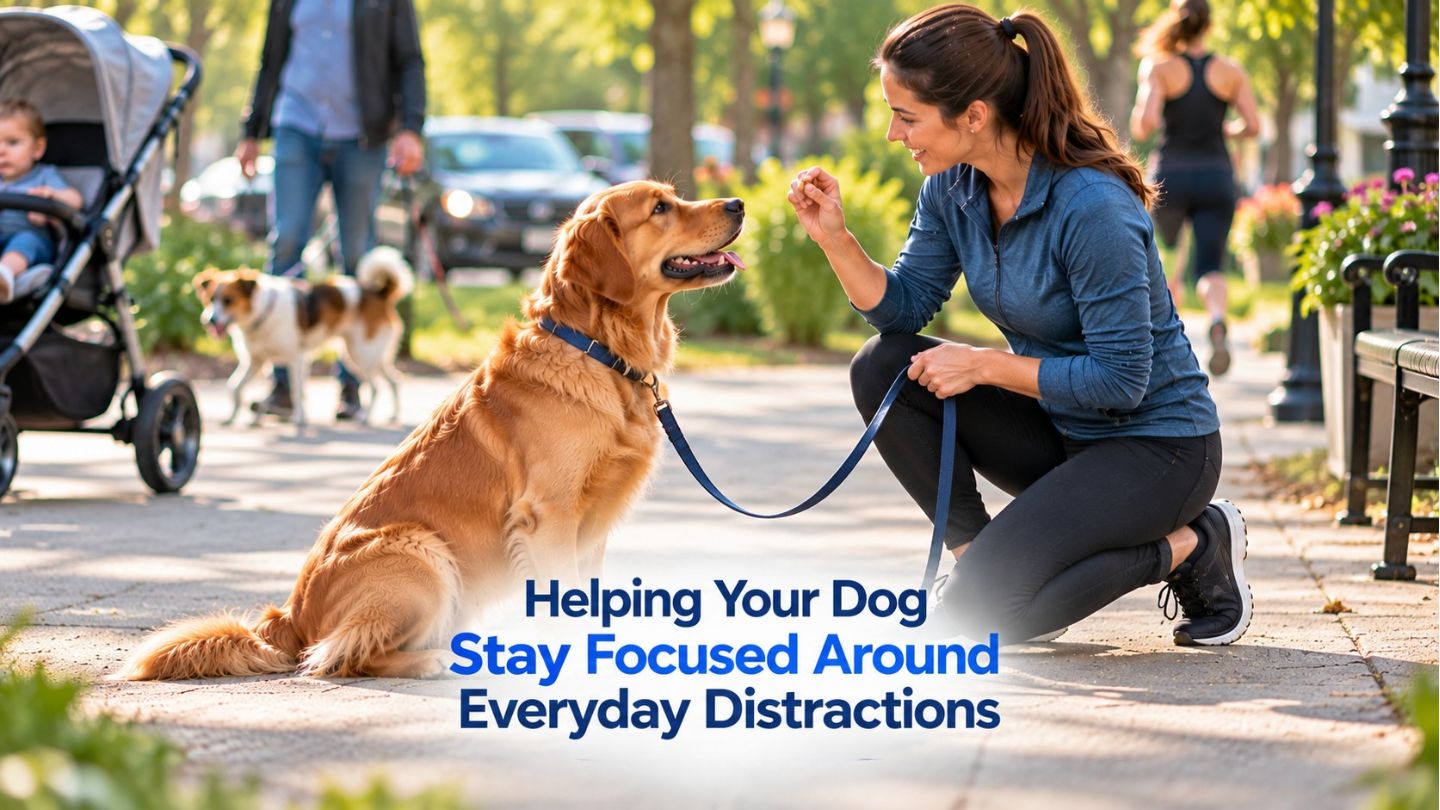
The best focus training doesn’t feel like training at all – it feels like play. Engagement-building exercises help dogs choose their owners over distractions, and they can happen during the most ordinary moments of your day: walking to the mailbox, taking out the trash, or waiting while your kids load into the car. These games turn distractions from battles into opportunities.
Distraction training requires consistent practice in various environments, but that practice doesn’t need to be formal. A few seconds of connection during a walk to the car is real training.
Some distractions are harder than others. A piece of food on the ground might be easy for one dog to ignore but impossible for another. A calm person walking past might be fine, but a child running and shrieking could send your pup into overdrive. The key is addressing one type of trigger at a time so your dog can build confidence without being overwhelmed.
Teach your dog to notice distractions without fixating on them. The goal isn’t to pretend the squirrel doesn’t exist – it’s to acknowledge it and choose you instead.
Working near other dogs: Start at a distance where your dog can still respond to cues. Ask for simple behaviors – a sit, a watch, a check-in – and reward immediately. Gradually decrease distance only when your dog remains composed. Exercises such as practicing distraction down-stays help dogs build the ability to maintain focus and remain calm even when their surroundings become more challenging. For context, service dogs must learn to ignore other dogs completely, which shows just how far this skill can be developed with patience and the right training process. Service dog training relies heavily on this kind of progressive distraction work.
Handling people triggers: When a delivery driver approaches, a neighbor walks past, or visitors arrive at the door, use a mat or bed cue to give your dog a clear job. Practice having your dog hold a sit and maintain focus while someone walks by or rings the bell. Reward calm behavior every time.
Managing noise: Urban and suburban environments are full of sound triggers – traffic, construction, lawn equipment, garbage trucks. Pair these sounds with calm, focused behavior and high-value rewards:
Dogs need to see their owner as the most rewarding part of their environment. When your dog learns that exciting, noisy, or crowded moments are opportunities to earn something wonderful from you, their default response shifts from reactive to attentive.
There’s a meaningful difference between a dog who gets easily distracted by a squirrel and a dog whose behavior escalates into something more intense. Normal distraction looks like a dog who perks up, pulls a bit, or momentarily tunes you out. A deeper concern looks like:
These patterns often involve fear, anxiety, or reactivity that goes beyond simple distraction. In these cases, structured behavior modification with a qualified professional trainer is safer and far more effective than trying to work through it alone. Training a dog to ignore distractions at this level takes months of daily practice with expert guidance.
Professional programs can be tailored to specific goals: improving leash manners, reducing anxiety around triggers, building confidence in public spaces, or preparing a dog for therapy or service roles. Whether through group class settings, private lessons, virtual coaching, or immersive programs, the right support matches the dog’s needs and the owner’s goals. Professional guidance can also support other important areas of development, including establishing consistent routines and addressing challenges such as housebreaking a dog or puppy.
Helping a dog stay focused around everyday distractions requires patience, consistency, and a training approach that matches the dog’s individual needs. By understanding what triggers distractions and building better communication through structured practice, owners can create calmer and more confident experiences during walks, outings, and daily routines.
At Comprehensive Pet Therapy, we help dogs develop reliable skills through programs designed around their behavior and training goals. From beginner obedience and intermediate obedience to specialized options like tricks classes and service dog training, our team provides guidance for different stages of learning. We also offer in-home private instruction for personalized support and help families work with experienced dog trainers in Sandy Springs who understand real-world training challenges. Contact us to learn how we can support your dog’s training journey with a program that fits your needs.
Begin indoors with simple eye contact exercises and name-response games. Start training in a boring environment with minimal distractions, reward even brief moments of attention, and go at your dog’s pace. Once your dog reliably responds inside, move to slightly busier spots like a driveway or quiet sidewalk.
If your dog ignores you outside, increase distance from the distraction and switch to an easier location. Use very motivating rewards – a high-value treat your dog doesn’t see at other times works well. Practice a few short focus games before heading into more challenging areas so your dog is already in an engaged mindset.
Dogs of any age can improve their focus with consistent, reward-based practice. Adult and senior dogs may benefit from shorter training sessions and more gradual changes in environment. Research shows that dogs with a history of ongoing training maintain stronger attention skills as they age, so it’s never too late to start.
Keep sessions brief and frequent. Sprinkling short focus games throughout the day is far more effective than one long session that drains your dog’s attention. End each round while your dog is still engaged and enthusiastic – this builds anticipation and makes the next session even more productive.
Work at a distance where your dog can still respond to simple cues. Reward calm behavior generously, and only decrease distance when your pup remains composed. If your dog continues to lunge, bark, or panic despite consistent practice, a customized behavior plan with a professional trainer is the safest path forward.
A professional can assess your dog’s specific triggers, design step-by-step distraction training tailored to your dog’s behavior, and coach you on handling techniques for real-world settings. Structured options can include group obedience, private lessons, virtual coaching, or immersive programs, depending on your dog’s needs and your goals.

Need to get in touch with CPT? I’ve got you covered.
Pick what works best for you!


