You’re at the park, your dog spots a squirrel, and the word “come” leaves your mouth – but your dog doesn’t even glance back. Or maybe guests arrive, and you ask for a “sit” at the front door, only to watch your dog leap at everyone who walks in. If these moments sound familiar, you’re not alone. Understanding the role of verbal cues in effective dog training is the key to turning those frustrating scenarios into calm, reliable responses.
This article covers what verbal cues actually are, why they matter so much for safety and everyday harmony, how to teach them step by step, and how to use them in real life with your family dog. Everything here is practical, grounded in evidence, and designed for pet parents who want calmer walks, better manners, and a stronger bond built on clear communication.
Verbal cues are specific words or short phrases you say out loud to signal a particular behavior. Think of everyday spoken commands like “sit,” “down,” “stay,” “come,” and “leave it.” Each word acts as a distinct auditory signal that tells your dog exactly what you’d like them to do in that moment.
These cues differ from hand signals, physical lures, and body language cues, though in practice all of these elements often work together. A hand signal simultaneously paired with a verbal cue can be powerful, but the spoken word itself carries its own meaning once your dog has learned to associate it with a behavior and a reward.
The way dogs learn verbal cues follows a simple process: a sound is paired with a behavior, and that behavior is followed by a consequence – usually something the dog enjoys, like a treat, praise, or play. Over time, the dog comes to associate that specific sound with a specific action and the good things that follow. This is how verbal cues become meaningful and reliable rather than just noise.
In real life, verbal cues look like this: you say “sit” at the doorway before opening the door, and your dog’s rear hits the ground. You call “come” from the back porch, and your dog trots in from the yard. You say “bed” at night, and your dog settles onto their mat. These small moments of clear communication add up to a calmer, more predictable household for everyone.
Dogs don’t speak English – or any human language – the way we humans understand it. They focus far more on patterns, tone, and consistent outcomes than on the actual phonetics of a word. A verbal cue only becomes meaningful through repetition and reliable consequences. Dogs process verbal cues as conditioned predictors of reinforcement or action, learning to associate specific sounds with actions and subsequent rewards through conditioning.
This means a cue must be clear, short, and used the same way by every person in the home to become reliable. Using a single clear word creates an auditory target that dogs can easily recognize. If one family member says “come here,” another says “come on,” and a third just calls the dog’s name, the dog has to wonder which sound actually means “run back to the human for something good.” That confusion slows learning dramatically.
Here’s a quick example of clarity versus confusion:
The fix is straightforward: decide on one simple, distinct word for each core behavior, and make sure every person in the household uses that exact same cue. Short, crisp verbal cues work better than long phrases because they’re easier for dogs to distinguish from the stream of human conversation happening around them all day.
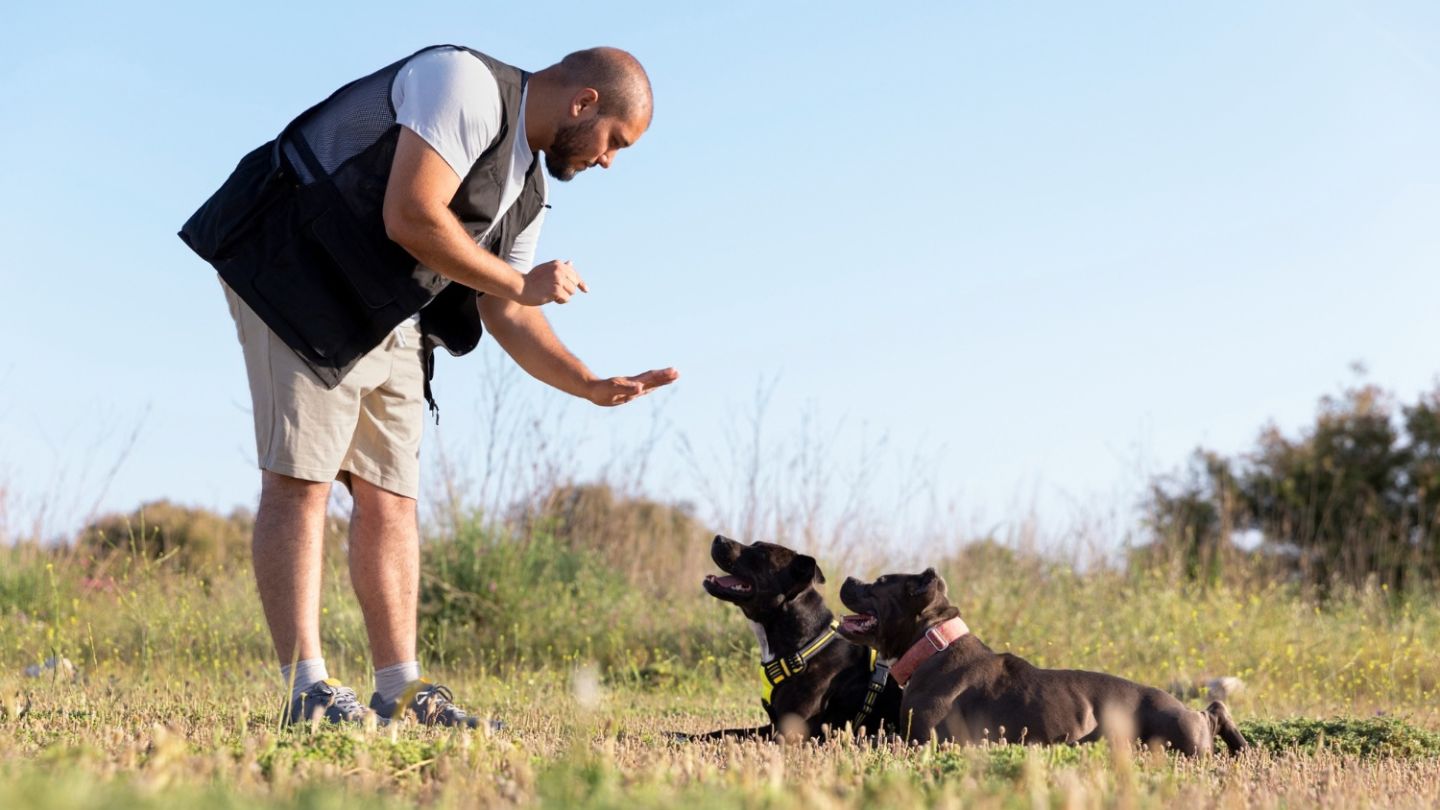
Strong verbal cues make daily life safer and more enjoyable. Consider the situations where visual cues aren’t possible: it’s dark outside, your dog is behind furniture, you’re on a trail, and your hands are full of groceries, or you’re managing a leash and a stroller at the same time. In every one of these scenarios, your voice is what you have. Fluent verbal cues allow handlers to guide dogs effectively, even in distracting environments where sight lines are limited. Understanding how structured training environments help dogs build reliable responses can make a significant difference, especially for owners who want to know what happens inside professional dog training classes before getting started.
Verbal cues also give your dog a clear job when they might otherwise default to unwanted behavior. Instead of barking at the delivery person, a dog who understands “bed” can go settle on their mat. Instead of dashing through an open door, a dog who knows “wait” can pause until released. This is how verbal commands replace guesswork with predictability for your dog – and for you.
Reliable verbal cues are also the foundation for more advanced work. Whether the goal is therapy visits, agility, or service tasks, precision matters. A dog who responds to a solid “stay” while a delivery is made, or offers a reliable “come” away from a squirrel at the park, has the kind of verbal fluency that opens doors to richer experiences together.
Effective training is built around understanding your dog’s responses and creating clear communication, because communication matters more than simply teaching commands. You stop repeating yourself. Your dog stops guessing. The result is more trust, less stress, and far less yelling or nagging – which benefits everyone in the household.
Calmly delivered verbal cues can lower a dog’s heart rate and stress levels, creating a sense of security. This is especially important for sensitive or reactive dogs who feel more confident when they know exactly what’s expected. Consistent verbal cues foster predictability in dog training and behavior, and predictability is what helps anxious dogs relax.
Imagine a family that can finally enjoy relaxed walks and visitors because the dog understands “bed,” “quiet,” and “leave it.” The dog isn’t locked away or held back – they’re included, participating in family life because they have a shared language with their humans. That’s the real difference strong verbal cues make: they let you include your dog in more of your life, with confidence on both sides.
Teaching a verbal cue follows the same basic process for most behaviors, whether you’re working on “sit,” “down,” “stay,” or “come.” The approach is simple: first teach the action, then attach the word, then practice in gradually different contexts. You don’t need long training sessions – just short, focused moments throughout the day.
As your dog becomes more comfortable responding to cues, gradually introducing distractions helps build reliability in real-world situations, which is why distraction-based training is used in dog obedience programs.

The real value of verbal cues appears outside formal training sessions. Using cues naturally throughout daily routines helps turn learned behaviors into reliable habits. Consistency is the most important factor -every person in the household should use the same words, tone, and expectations so the dog can clearly understand what is being asked.
Simple moments throughout the day can become training opportunities. Asking for a “sit” before meals, using “wait” before opening doors, or practicing “come” during walks helps reinforce cues in real-world situations. These repeated experiences strengthen the connection between the word, the behavior, and the reward.
Pairing verbal cues with rewards that matter to your dog also improves learning. Some dogs respond best to treats, while others are motivated by praise, play, or access to something they enjoy. Choosing the right reward helps make training more effective and keeps your dog engaged.
Consistent practice builds reliability over time. When your dog hears the same cue, performs the expected behavior, and receives a positive outcome, the association becomes stronger and easier to maintain in different environments
Even well-meaning owners can accidentally weaken their verbal cues. Here are some common habits and what to do instead:
Sometimes home practice reaches a point where progress stalls. If your dog shows intense fear, reactivity, or difficulty focusing even in quiet environments, it may be time to bring in professional support. This isn’t a last resort – it’s a proactive step that many of our clients take early because it saves time and reduces stress for everyone.
A skilled trainer can assess your timing, word choice, body language, and reward use to identify exactly where the communication is breaking down. Often, small adjustments – a slight change in when you deliver the cue, or how you mark the correct response – can produce a remarkable difference in your dog’s reliability. A professional dog training evaluation process can also help identify areas where your dog may need additional guidance and create a training approach based on their specific behaviors and needs.
Look for programs that use modern, evidence-based methods and can tailor verbal cue plans to your dog and your household. Whether you’re interested in group obedience, private lessons, virtual coaching, or board-and-train focused on verbal reliability, there are options designed to meet you where you are. Visit cpt-training.com to explore training programs and find the right fit for your goals.

Verbal cues create a foundation for clearer communication between dogs and their owners. When taught with patience, consistency, and positive reinforcement, simple words can help dogs understand expectations, respond more reliably, and feel more confident in everyday situations. Whether you are working on basic manners or improving specific behaviors, the right approach helps turn training into a more rewarding experience for both you and your dog.
At Comprehensive Pet Therapy, we help families strengthen their connection with their dogs through personalized training solutions. From addressing challenges through our growl class and support for excessive barking to providing in-home private instruction and service dog training, our programs are designed around each dog’s unique needs. If you are looking for professional dog training in Sandy Springs, contact us to learn how we can help you build better communication and lasting results with your dog.
Dogs can learn to associate specific words with specific actions and outcomes – so yes, the word itself does matter. However, tone and body language still play a significant role in how your dog interprets what you’re saying. Dogs respond better to verbal cues in a cheerful tone, and research shows their brains process word meaning and intonation separately, much like humans do. Consistent pairing of a word, a behavior, and a reward is what gives the word its meaning for the dog.
Keep sessions short and frequent throughout the day rather than scheduling one long training block. Brief training moments before meals, walks, or play are ideal. Emphasize quality over length: end while the dog is still engaged and successful, and mix practice into daily routines so the cues become part of real life, not just a formal exercise.
Absolutely. Adult and senior dogs are fully capable of learning new behaviors and new verbal cues, as long as training is clear, patient, and tailored to their comfort level. Dogs can learn to respond to many verbal cues regardless of age. If you have concerns about hearing, vision, or mobility that might affect your dog’s training, a quick check with your veterinarian can help you adapt your approach.
Avoid repeating the word louder or more forcefully. Instead, help the dog succeed with a prompt – a gentle lure or gesture – and then reward that success. Afterward, ask yourself whether the distraction was too big, the reward was too small, or whether the dog fully understood the cue in that particular context yet. Go back to an easier setting and rebuild from there. Distinct verbal cues should be accompanied by consistent rewards to strengthen learning associations.
A dog’s name works best as an attention-getter, not as the behavior cue itself. Use a pattern like “Name → pause → cue → reward” so the dog learns to look at you when they hear their name, then respond to the next word. This keeps the name meaningful as a way to say “hey, listen up” without overloading it with behavioral expectations. Even cats and other pets learn this kind of attention pattern, but for dogs it’s an especially important foundation that makes every verbal cue that follows more effective.


Need to get in touch with CPT? I’ve got you covered.
Pick what works best for you!